Idea: fluid buffer/equalizer#5246
Idea: fluid buffers (“equalizers” if you want to be fancy): a small (1x1?) device with a single pipe attachment that acts like a smaller (180L?) version of a fluid tank that’s attached to the same pipe on both ends.
This would be useful for cases where the same pipe feeds into machines or launchers that work at different rates; the buffer would allow the pipe to put excess fluid into the buffer when demand is low and temporarily feed more from the buffer when demand is high, evening out the flow.
As indicated, the functionality already exists in the form of fluid tanks, but their footprint is quite big (2x2 plus a pipe connection between the two ends at which point it’s closer to 3x3) and 3,600L is much larger than needed for a buffer when fluid pellets are 60L and machines have internal buffers that are like 180L.
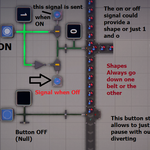
yes fluids really act strange for me … one painter is at 100% and another on the same string of 6 is at 30% i sort of solved it wiht using a tank or a “wires valve” with at 1 as input … to me it makes no sense that the tank that is full doesnt provide more fluid volume if there are 1200 L in the tank shouldn’t it make up for the missing volume by lowereint so how can a full tank on the end of a string not provide enough fuid to keep the 300L needed
This is intended though: A fluid tank (no matter how full) will only provide up to one fluid catcher worth of fluid to a pipe (so 1,200/1,500/1,800 L/min), and 6 painters need 1.5 fluid launchers worth of input (1,800/2,250/2,700 L/min). Of course this could be done differently but I’m quite sure that it’s a deliberate game design decision.
The fluid buffer wouldn’t change that either. The only case where a buffer on a pipe helps is when there’s enough throughput on the input side to feed the output side on average but the input and/or output operate at uneven rates. https://discord.com/channels/1000343719314198548/1506389399716233377 is an example of that.
So explain it so that i can understand ! – there should be a way to accumulate Fluid and output it so that there is sufficient volume to feed X painters –
I don’t understand the logic of having tanks if they can’t fill and later empty when the volume is low on the output side of the line – What are tankes even for then ?
=========================================
Simple situation that includes my design idea
a train delivers Fluid to the unloader … and it gets stored on the platform in tanks
I keep these tanks supplied via train cars so that a platform has several tanks of the Primary colours and once secondary colours are available via mixing - i have a set of tanks for them and mixers to fill them … I wish that there was a wire system componet like the one for the belts that reads the flow volume of pipes ! (tbh i like the Shapez origional system of being able to send the fluids on containers on the belt - i made good use of that … sending a belt with shapes to be painted and thier paint “packageds” on the same belt and used the filter to direct the paint and the shapes to a painter that wasn’t currently in use - fluids need better wire support in SHAPEZ 2 )
When shapes arrive (via train ) the shapes are unloaded and painted the painters should run at full capasity at all times since there is an over abundance of paint available in all the tanks –> as i understand what yuou are saying is that i need 2 or 3 tanks output connected to every painter to make that happen ?
One fluid tank output can supprt 4 painters (so enough to paint one full belt), same as a single fluid catcher. But if you want to scale that up to 12 belts you’ll need 12 fluid tanks. If it’s for pre-mixed colors in a MAM, that’s per color, and you’d also need as many pipe gates…
I really have no convincing use case for fluid tanks. Even buffering for trains can be done more easily (in my opinion) by relying on the internal buffering of the fluid unloaders. If that buffer is too small, one can use several fluid unloaders on the same space pipe and longer trains.
There is the use case for pipes with uneven flow described here, but with fluid tanks so big I’ve found it easier to even out the flow than to actually incorporate fluid tanks for buffering.